2.1.1
Computational Thinking
Computational thinking is about approaching problems in a clear, organised way. It focuses on three main ideas: abstraction, decomposition, and algorithmic thinking. If you understand how each one helps break down and refine a problem, you are already covering the key exam skill.
On this page8 sectionsHide
What you need to know
- Define abstraction, decomposition, and algorithmic thinking.
- Explain how each principle helps solve problems.
- Apply the three principles to a scenario.
Big Picture
What computational thinking means
Computational thinking is not just for writing programs. It is a way of understanding and solving problems logically.
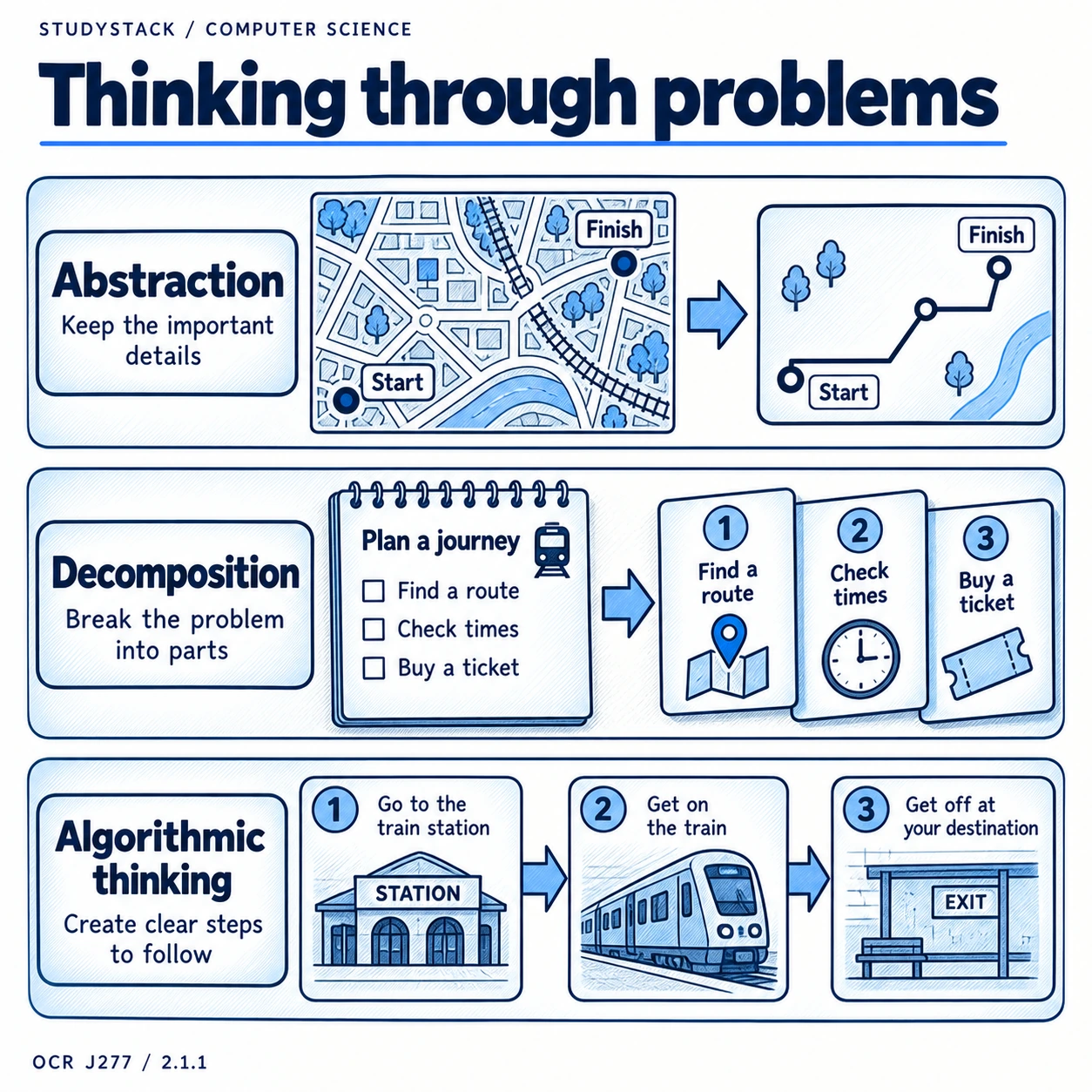
- It helps you focus on what matters.
- It helps large problems feel more manageable.
- It helps you plan solutions clearly before coding.
Principle 1
Abstraction
Abstraction means ignoring unnecessary detail so you can focus on the important parts of the problem.
A map is a good example of abstraction. It leaves out huge amounts of real-world detail and only keeps the information needed for the journey.
In Computer Science, abstraction makes a problem easier to understand because it reduces distraction and complexity.
Exam wording
A strong answer says abstraction removes unnecessary detail to make the problem easier to solve.
Principle 2
Decomposition
Decomposition means splitting a large problem into smaller, more manageable parts.
If you were designing a game, you might split it into movement, scoring, menus, and collision detection rather than trying to solve everything at once.
- Each smaller part is easier to understand.
- Different parts can be designed or tested separately.
- Decomposition often leads to more organised solutions.
Principle 3
Algorithmic thinking
Algorithmic thinking means planning a solution as a sequence of logical steps.
This is the stage where you think carefully about what the computer or user must do first, next, and last.
It links directly to writing algorithms, flowcharts, and pseudocode later in the course.
High-Value Exam Skill
Applying the three ideas together
Most real exam questions expect you to apply more than one of these ideas at the same time.
- Abstraction: decide which details can be ignored.
- Decomposition: split the problem into smaller tasks.
- Algorithmic thinking: turn the tasks into a logical order of steps.
Revision shortcut
A neat way to remember this topic is simplify, split, and step through.
Key takeaways
- Computational thinking helps solve problems in a structured way.
- Abstraction removes unnecessary detail.
- Decomposition breaks a problem into smaller parts.
- Algorithmic thinking turns a solution into a sequence of clear steps.
Glossary
- Computational thinking
- A logical way of understanding and solving problems.
- Abstraction
- Removing unnecessary detail to focus on what matters.
- Decomposition
- Breaking a problem into smaller parts.
- Algorithmic thinking
- Planning a solution as clear, ordered steps.
Test yourself
4 questions
What does abstraction do?
It removes unnecessary detail so the important parts are easier to focus on.
What does decomposition do?
It breaks a large problem into smaller, more manageable parts.
What does algorithmic thinking produce?
A clear sequence of steps for solving a problem.
Why are these ideas useful together?
They help simplify, organise, and structure a solution.
Common questions
Do I need to write code to show computational thinking?
Not always. You may explain the ideas in words or apply them to a scenario without writing a full program.
Can one problem use all three ideas at once?
Yes. Real problems often need abstraction, decomposition, and algorithmic thinking together.
Why is abstraction useful?
Because it removes distracting detail and helps you focus on the key parts of the problem.