1.6.1
Ethical, Legal, Cultural and Environmental Impact
Digital technology changes how people live, work, communicate, and make decisions. You need to discuss both positives and negatives, understand key legislation, and compare open source with proprietary software in a balanced way.
On this page12 sectionsHide
- How digital technology affects society
- Ethical issues
- Privacy, personal data, and consent
- The key terms this topic uses
- The legislation you need to know
- Open source vs proprietary software
- Cultural impacts of technology
- Environmental impacts of technology
- How to write a strong “discuss” answer
- Key takeaways
- Glossary
- Test yourself
What you need to know
- Discuss ethical, legal, cultural, environmental, and privacy impacts of digital technology.
- Explain the purpose of the Data Protection Act 2018, Computer Misuse Act 1990, and Copyright Designs and Patents Act 1988.
- Compare open source and proprietary software.
- Write balanced answers that include both benefits and drawbacks.
Big Picture
How digital technology affects society
This topic is about understanding how technology changes real lives and being able to discuss those changes clearly.
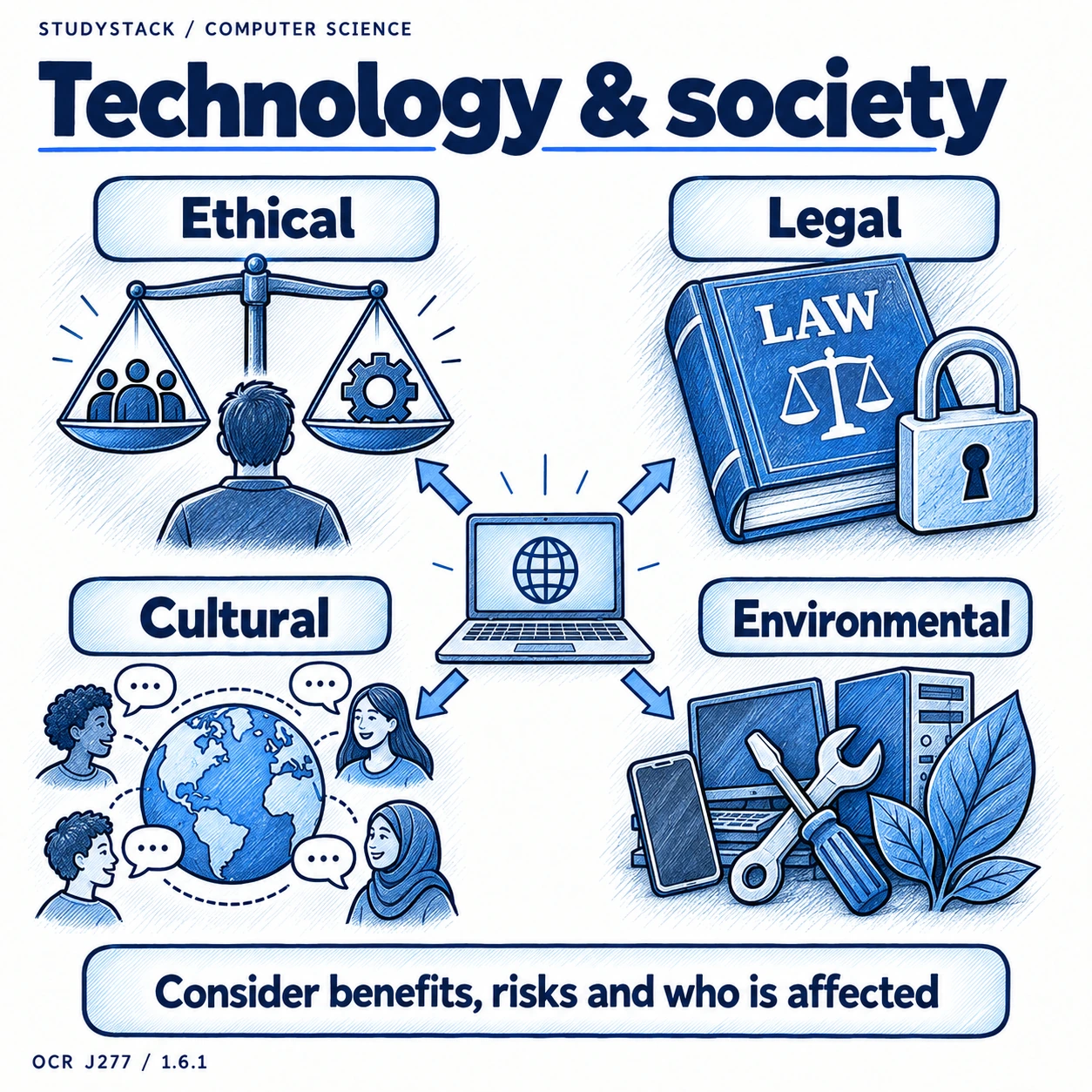
- Ethical issues focus on what is right or wrong.
- Legal issues focus on what the law allows or forbids.
- Cultural issues focus on how society and lifestyles change.
- Environmental issues focus on energy use, waste, and sustainability.
- Privacy issues focus on how personal data is collected and used.
People and Data
Ethical issues
Ethical questions are about what should happen, not just what can happen.
Examples include surveillance, targeted advertising, fake news, cyberbullying, and how social media platforms influence behaviour. Technology can help people connect and stay informed, but it can also be used to mislead, monitor, or manipulate them.
A good ethical answer considers whether people are being treated fairly, whether they understand what is happening, and whether they have a real choice.
Balanced answer move
If a question asks you to discuss an issue, try to give at least one benefit and one drawback before reaching a judgement.
People and Data
Privacy, personal data, and consent
Privacy questions usually become clearer when you focus on who knows what about a person and who controls that information.
Privacy issues arise when organisations collect, store, or share personal data. Think about whether users understand what is being collected, how long it is stored for, and whether it will be shared with others.
Consent means permission. It is worth mentioning whether the user has given informed consent rather than just clicking something without understanding the consequences.
- Personal data can include names, locations, habits, contact details, or online behaviour.
- Privacy is about control over personal information.
- Loss of privacy can happen even when a service is convenient.
Key Ideas
The key terms this topic uses
Once the core words are separated clearly, the rest follows.
- Ethical means about right and wrong, even if something is technically legal.
- Legal means about what the law allows or forbids.
- Privacy means control over personal information and how it is used.
- Cultural means how people live, work, communicate, and take part in society.
- Environmental means the effect on resources, energy use, waste, and sustainability.
High-value distinction
Something can be legal but still raise ethical concerns. That difference often earns marks in discussion questions.
Law
The legislation you need to know
You need to name the legislation and explain the purpose of each law, not just make vague comments about “computer laws”.
| Law | What it protects or controls | Example of what it stops |
|---|---|---|
| Data Protection Act 2018 | Personal data and how organisations use it | Using personal data unfairly or without proper reason |
| Computer Misuse Act 1990 | Computer systems from unauthorised access or modification | Hacking into a system without permission |
| Copyright, Designs and Patents Act 1988 | Original creative work such as software, music, and images | Copying software illegally without permission |
Software Choices
Open source vs proprietary software
A software licence sets out how software can be used, copied, or modified.
- Open source may suit a scenario where customisation matters most.
- Proprietary software may suit a scenario where official support matters most.
| Type | Feature | Benefit | Drawback |
|---|---|---|---|
| Open source | Source code is available | Can be customised and improved by users or developers | Support may be less formal or less guaranteed |
| Proprietary | Source code is not available | Often comes with commercial support and official updates | Usually costs money and offers less freedom to modify |
Scenario skill
If a company needs formal support, proprietary software may be the better choice. If flexibility and customisation matter more, open source may be better.
Wider Effects
Cultural impacts of technology
Cultural impact is about how technology changes everyday life and society.
- Cultural changes include remote working, online communities, and greater global communication.
- Digital divide issues can leave some people with less access to opportunities.
- Technology can change how people socialise, shop, learn, and access services.
- Some cultural changes are positive for access and convenience, but others can increase isolation, dependence, or unfairness.
Wider Effects
Environmental impacts of technology
Environmental impact is mainly about resources, energy, waste, and sustainability.
- Environmental impacts include energy use, electronic waste, and the resources needed to manufacture devices.
- Data centres and always-on services can use large amounts of electricity.
- Old devices can create e-waste if they are not reused or recycled properly.
- Technology can also reduce travel or paper use, so some impacts can be positive as well as negative.
Exam Technique
How to write a strong “discuss” answer
The examples are usually the easy part. Marks get lost when the answer reads as a list rather than an argument.
- Name the issue clearly first, such as privacy, ethics, or environmental impact.
- Give one clear benefit of the technology in context.
- Give one clear drawback in context.
- Finish with a judgement about which side matters more in that scenario.
Simple structure
Issue, benefit, drawback, judgement is a strong pattern for extended response questions in this topic.
Key takeaways
- Technology can improve life, but it can also create privacy, ethical, and environmental concerns.
- You need to name the legislation and explain what each law allows or prevents.
- Open source and proprietary software have different strengths and drawbacks.
- Strong exam answers usually show balance rather than only listing positives or negatives.
Glossary
- Ethics
- Ideas about what is right and wrong.
- Privacy
- A person’s right to control who can access their personal information.
- Legislation
- Laws created to regulate behaviour and protect people or property.
- Consent
- Permission given by a person for their data to be collected or used.
- Personal data
- Information that relates to an identifiable person.
- Surveillance
- Monitoring people, behaviour, or activity, often using digital technology.
- Digital divide
- The gap between people who have easy access to digital technology and those who do not.
- Open source
- Software where the source code is available to view and change.
- Proprietary
- Software where the source code is not available to the user.
Test yourself
6 questions
Which law covers unauthorised access to a computer system?
The Computer Misuse Act 1990.
Which law protects personal data?
The Data Protection Act 2018.
What is the difference between open source and proprietary software?
Open source gives access to the source code, while proprietary software does not.
Give one environmental issue linked to digital technology.
Electronic waste, energy use, or the environmental cost of manufacturing devices.
What is the digital divide?
It is the gap between people with good access to digital technology and those with limited access.
What does consent mean in a privacy discussion?
It means the user has given permission for data to be collected or used, ideally with a clear understanding of what that involves.
Common questions
Why do exam questions ask for both positives and negatives in this topic?
Because technology affects different people in different ways, so strong answers need balance rather than one-sided claims.
Do I need to memorise every detail of each law?
You mainly need the law names, what each one protects, and the kinds of actions each one allows or prevents.
Why do software licences matter?
They make clear how software can legally be used, copied, shared, or modified.