1.2.4a
Data Storage (Numbers)
The number systems and methods you need to know: denary, binary, and hexadecimal conversion, binary addition and overflow, most and least significant bits, and the effect of left and right shifts. Once the patterns are clear, these questions become very predictable.
On this page10 sectionsHide
What you need to know
- Convert positive denary whole numbers to 8-bit binary and back again.
- Add binary numbers and explain overflow errors.
- Convert between denary, binary, and 2-digit hexadecimal.
- Understand MSB and LSB and explain the effect of left and right shifts.
Big Picture
The three number systems you need
You need to move confidently between denary, binary, and hexadecimal.
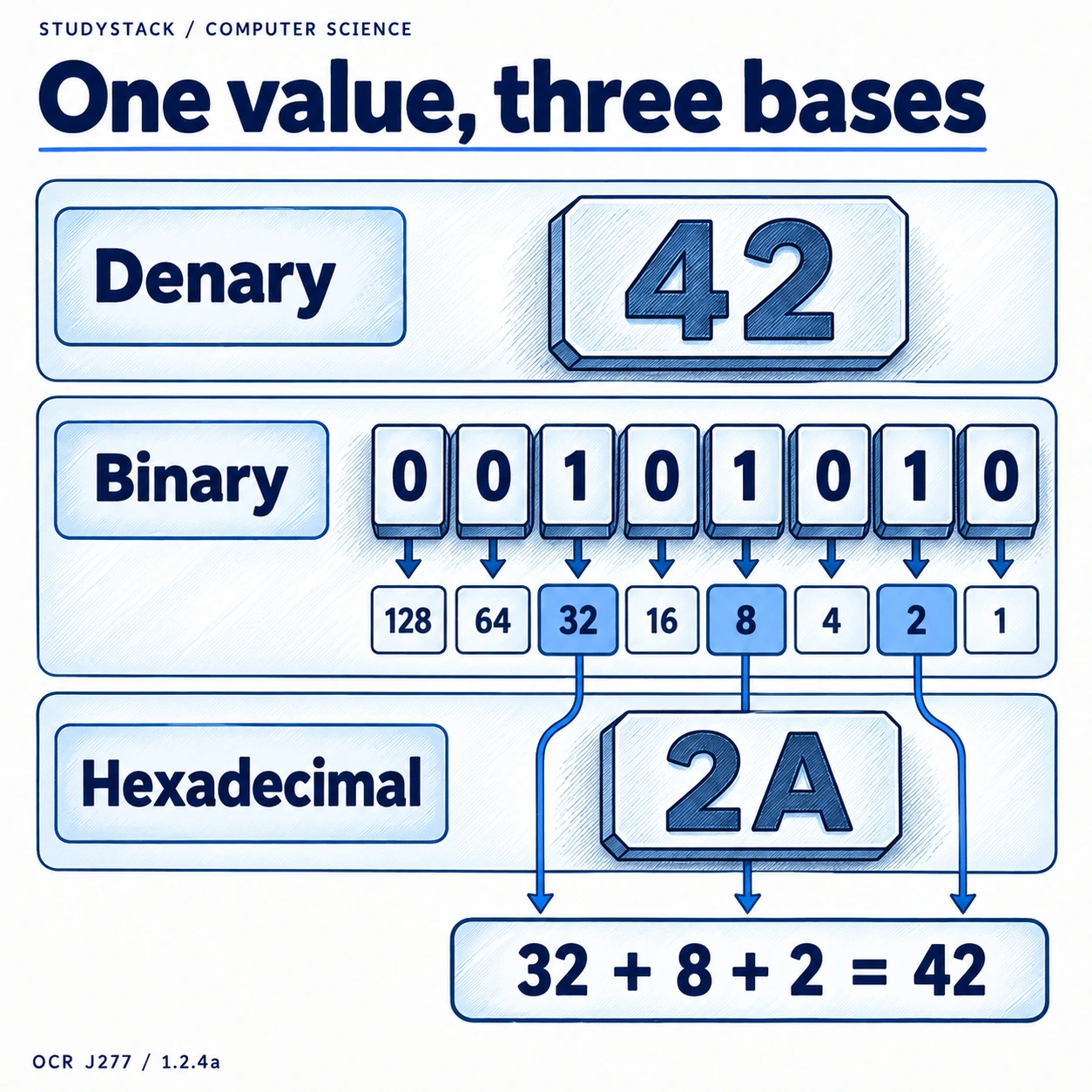
- Denary is the normal base 10 number system used in everyday life.
- Binary is base 2 and uses only 0 and 1.
- Hexadecimal is base 16 and uses 0 to 9 and A to F.
- Hex is used because it is easier for humans to read than long binary strings.
Quick memory aid
Denary = 10 symbols, binary = 2 symbols, hexadecimal = 16 symbols.
Must Know
8-bit binary and place values
Every bit in an 8-bit number has a place value, just like columns in denary.
From left to right, the place values are 128, 64, 32, 16, 8, 4, 2, and 1. To read a binary number, add the values of the columns that contain a 1.
The largest 8-bit value is 11111111, which equals 255. The smallest is 00000000, which equals 0.
- 8-bit place values: 128, 64, 32, 16, 8, 4, 2, 1.
- MSB means most significant bit, the leftmost bit.
- LSB means least significant bit, the rightmost bit.
- Leading zeros do not change the value.
Range
You usually work with positive numbers in the range 0 to 255 using up to 8 bits.
Core Method
Converting between denary and binary
These conversions are much easier when you stay calm and follow a method every time.
To convert binary to denary, add the place values where a 1 appears. For example, 00101111 is 32 + 8 + 4 + 2 + 1 = 47.
To convert denary to binary, start with the largest place value that fits into the number, write a 1 there, subtract it, and repeat. Put 0 in any column you do not use.
- Binary to denary: add the values of the 1 columns.
- Denary to binary: subtract the largest fitting place values.
- Write answers as 8 bits when the question expects 8-bit form.
Simple rule
Binary to denary means add. Denary to binary means subtract the biggest columns that fit.
Exam Skill
Binary addition and overflow
Binary addition follows the same idea as denary addition, but you carry groups of 2 instead of groups of 10.
The key rules are: 0 + 0 = 0, 0 + 1 = 1, 1 + 1 = 10, and 1 + 1 + 1 = 11. In the last two cases you write one bit and carry one to the next column.
Overflow happens when the true result needs more bits than the computer has available. In an 8-bit system, any result above 255 causes overflow.
- 1 + 1 gives 0 and carry 1.
- 1 + 1 + 1 gives 1 and carry 1.
- Overflow means the result is too large to fit in the available bits.
- In 8 bits, values above 255 overflow.
Common mistake
Overflow does not mean the calculation is wrong. It means the answer cannot be fully stored in the number of bits available.
Base 16
Hexadecimal and why it is useful
Hexadecimal is a shorter and more human-friendly way of showing binary data.
Each hexadecimal digit represents exactly 4 bits, which is one nibble. That means an 8-bit binary number can always be written as 2 hex digits.
The digits 0 to 9 work as normal, but A to F are used for the denary values 10 to 15. So the 2-digit hex range goes from 00 to FF.
- A = 10, B = 11, C = 12, D = 13, E = 14, F = 15.
- One hex digit = 4 binary bits.
- Two hex digits = one 8-bit byte.
- Hex is easier to read than long binary numbers.
Fast conversion trick
To convert binary to hex, split the 8 bits into two groups of 4 and convert each nibble separately.
Conversion
Converting between binary, denary, and hex
You may need to convert any number in the allowed ranges into another number base.
- Binary to hex: split into nibbles and convert each nibble.
- Hex to binary: turn each hex digit into a 4-bit nibble.
- Denary to hex: divide by 16 to find the left digit and remainder.
- Hex to denary: multiply the left digit by 16 and add the right digit.
Example pattern
A7 in hex means 10 groups of 16 plus 7, which is 167 in denary.
High-Value Exam Skill
Binary shifts
Shifts are one of the easiest places to gain marks if you learn the effect clearly.
A left shift moves every bit one place to the left and fills the new spaces with 0s. Each one-place left shift multiplies the number by 2.
A right shift moves every bit one place to the right and fills the new spaces with 0s. Each one-place right shift divides the number by 2.
- Left shift by 1 means multiply by 2.
- Left shift by 2 means multiply by 4.
- Right shift by 1 means divide by 2.
- Right shift by 3 means divide by 8.
Exam shortcut
If the question asks for the effect of a shift, you can often answer using powers of 2 without rewriting lots of text.
Key takeaways
- Denary is base 10, binary is base 2, and hexadecimal is base 16.
- An 8-bit binary number can represent values from 0 to 255.
- Overflow happens when a result is too large to fit in the available bits.
- A left shift multiplies by 2 for each place, while a right shift divides by 2 for each place.
Glossary
- Denary
- The base 10 number system used in everyday life.
- Binary
- The base 2 number system using only 0 and 1.
- Hexadecimal
- The base 16 number system using 0 to 9 and A to F.
- MSB
- Most Significant Bit, the leftmost bit in a binary number.
- LSB
- Least Significant Bit, the rightmost bit in a binary number.
- Overflow
- An error that happens when a result is too large to fit in the available bits.
Test yourself
5 questions
What is the maximum denary value of an 8-bit binary number?
255.
What does a left shift by one place do?
It multiplies the value by 2.
What does a right shift by one place do?
It divides the value by 2.
What does the hex digit F represent in denary?
15.
What is an overflow error?
It means the result is too large to fit in the number of bits available.
Common questions
What number range do I need for OCR J277 binary questions?
You usually work with positive denary values from 0 to 255, binary values from 00000000 to 11111111, and hexadecimal values from 00 to FF.
Why is hexadecimal used in computing?
Because it is much easier for humans to read and remember than long binary strings, while still matching binary neatly through groups of 4 bits.
How do I convert binary to denary?
Add the place values of the columns that contain a 1, using the 8-bit headings 128, 64, 32, 16, 8, 4, 2, and 1.
What does overflow mean in binary addition?
It means the correct result needs more bits than are available, so it cannot be stored fully in the given space.