2.2.3
Additional Programming Techniques
These programming techniques build on the fundamentals. You need to understand string manipulation, file handling, arrays and records, functions and procedures, SQL searching with SELECT/FROM/WHERE, and random number generation practically.
On this page10 sectionsHide
What you need to know
- Explain and use string manipulation, file handling, arrays, records, and random number generation.
- Understand functions and procedures and when each is useful.
- Explain local and global variables.
- Use the SQL keywords SELECT, FROM, and WHERE.
Handling Text
String manipulation
Programs often need to join, search, slice, or check pieces of text.
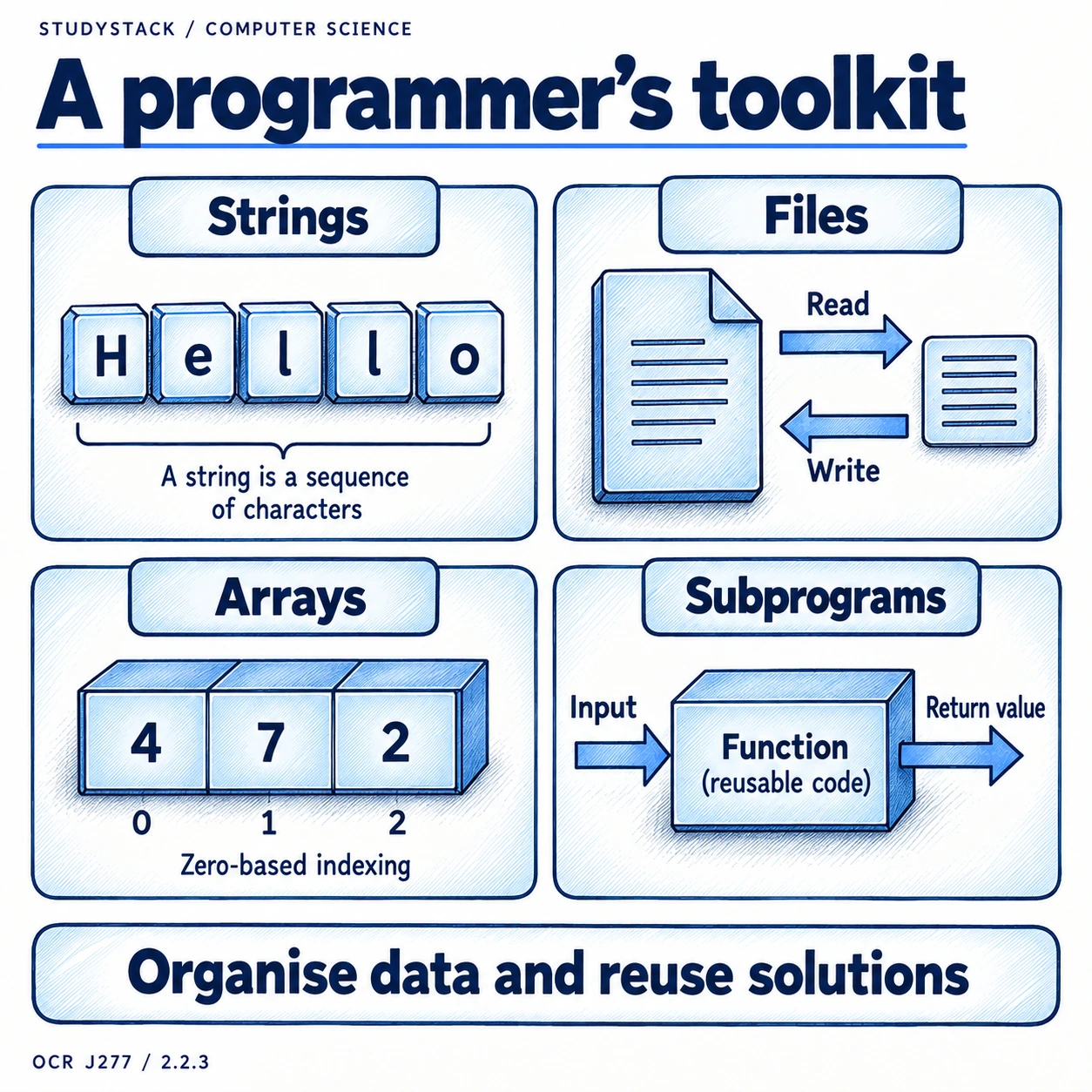
- Concatenation joins strings together.
- Slicing takes part of a string.
- Length checks how many characters are in the string.
- Case conversion can change text to upper or lower case.
Think practical
String manipulation is usually about making input usable, checking text, or formatting output clearly.
Permanent Storage
File handling
A variable only keeps data while the program is running. A file allows data to be kept after the program closes.
File handling means working with stored data in secondary storage rather than only temporary values in memory. This is why files are used for things like saved game data, account details, logs, or stored results.
- File handling commonly uses open, read, write, and close.
- Files let data be stored after the program ends.
- If data needs to be reused later, file handling is usually needed.
Organising Data
Arrays
An array stores multiple values under one name, usually values of the same type.
At GCSE level, arrays are treated as fixed-length or static structures. That means the size is decided when the array is created rather than growing automatically during the program.
A 2D array can be thought of like a table with rows and columns. This is useful for grids, seating plans, or game boards.
Quick distinction
An array stores many similar items under one name and position number.
Organising Data
Records
A record stores several related fields that belong to one item or one person.
For example, one student record might contain a name, candidate number, and total mark. The fields are not all “more of the same” in the way an array usually is.
Quick distinction
An array stores many similar items. A record stores several related facts about one item.
Structured Code
Functions, procedures, and variable scope
Subprograms make code easier to organise, test, and reuse.
A function is useful when the rest of the program needs a value back, such as a calculated total or a validation result. A procedure is useful when the aim is to carry out a task rather than return a value.
Scope means where a variable can be used. Local variables stay inside the subprogram that created them. Global variables can be accessed more widely, which can be useful but can also make code harder to manage.
- A function carries out a task and returns a value.
- A procedure carries out a task but does not return a value.
- Local variables are only available inside the subprogram.
- Global variables are available more widely in the program.
- The same ideas also apply to local and global constants.
- Arrays can be passed into subprograms and returned from them when a larger group of values needs to be processed.
Databases
Basic SQL
Only the basics are needed here, so keep the SQL simple and purposeful.
| Keyword or tool | Purpose |
|---|---|
| SELECT | Choose the fields to return |
| FROM | Choose the table to search |
| WHERE | Filter the rows returned |
Not required
You do not need advanced SQL such as joins, inserts, updates, or deletes.
Extras You Need
Random number generation
Random numbers are used when a program needs unpredictability, variety, or simulation.
- Random numbers can be used in games, simulations, or to generate test data.
- The program usually asks for a random value within a given range.
- In exam questions, focus on why randomness is useful rather than advanced maths behind it.
Key takeaways
- String methods let a program join, split, slice, or examine text.
- Files allow data to be stored permanently beyond the current run of the program.
- Arrays and records help organise related data in different ways.
- Functions return values, while procedures perform tasks.
- Basic SQL lets you select fields, choose a table, and filter rows.
Glossary
- Concatenation
- Joining strings together.
- File handling
- Opening, reading, writing, and closing files so data can be stored and reused.
- Array
- A data structure that stores multiple values under one name.
- Record
- A group of related fields stored together.
- Function
- A subprogram that returns a value.
- Procedure
- A subprogram that performs a task without returning a value.
- Scope
- The part of the program where a variable or constant can be accessed.
- SQL
- A language used to query data in a database.
Test yourself
5 questions
What is concatenation?
Joining strings together.
What four file operations should you know?
Open, read, write, and close.
What is the difference between a function and a procedure?
A function returns a value, while a procedure does not.
What is the difference between an array and a record?
An array stores many similar items, while a record stores several related fields about one item.
What does WHERE do in SQL?
It filters which rows are returned.
Common questions
Why use arrays instead of lots of separate variables?
Because arrays keep related values together under one name and make code easier to manage.
When should I use a function instead of a procedure?
Use a function when you need the subprogram to return a value for the rest of the program to use.
Why do programs use file handling?
Because files allow data to be stored permanently and used again later.