1.1.1
Architecture of the CPU
The CPU is the brain of the computer. It fetches instructions from memory, decodes them, and executes them one at a time in a continuous cycle. The key ideas here are Von Neumann architecture, the roles of the ALU, control unit, and cache, and the purpose of key registers including the MAR, MDR, program counter, and accumulator.
On this page9 sectionsHide
What you need to know
- Explain the three stages of the fetch-decode-execute cycle.
- Describe what the ALU, control unit, cache, and registers do.
- Distinguish clearly between an address and the data stored at that address.
- Know the purpose of MAR, MDR, program counter, and accumulator.
Big Picture
How the CPU fits into a computer system
The CPU does not work on its own. It sits at the centre of a wider system that takes in data, stores instructions, and produces results.
Input devices send data into the system. Main memory stores the instructions and data currently being used. The CPU processes that information, then sends the results to output devices or stores them for later use.
Secondary storage is used for long-term storage. It keeps programs and files even when the computer is switched off, while main memory is used for what the computer needs right now.
- Input devices provide data to be processed.
- The CPU processes instructions and controls the system.
- Main memory holds data and instructions currently in use.
- Output devices present the result to the user.
- Secondary storage keeps data and programs long term.
Core Model
What Von Neumann architecture means
The important thing here is the stored program concept rather than historical detail.
Von Neumann architecture means that program instructions and data are both stored in memory. The CPU fetches what it needs from memory and processes one instruction at a time.
This is important because the CPU can treat instructions as data to be read from memory. That is what makes the fetch-decode-execute cycle possible.
- Programs are stored in memory.
- Data is also stored in memory.
- The CPU fetches instructions from memory in sequence.
- Cache is used to reduce how often the CPU has to wait for main memory.
Exam shortcut
If a question asks for the stored program concept, state that both data and instructions are stored in memory and can be fetched by the CPU when needed.
Process
The fetch-decode-execute cycle
The CPU repeats the same cycle continuously while a program is running.
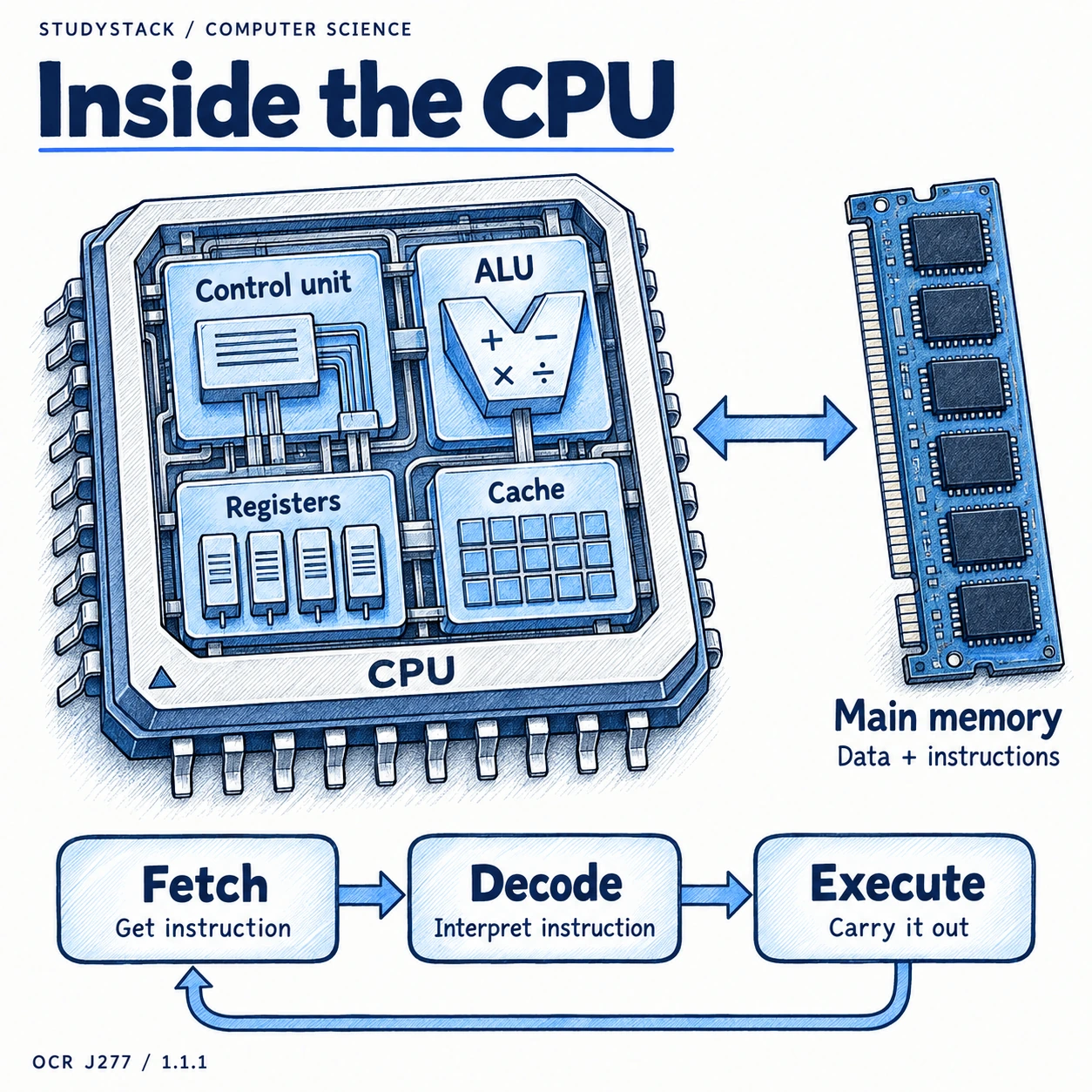
During fetch, the CPU gets the next instruction from main memory. During decode, the control unit works out what that instruction means. During execute, the processor carries out the instruction.
At GCSE level, you should focus on the action taking place at each stage. You do not need to memorise a long register-by-register trace for every single step.
- Fetch: get the next instruction from memory.
- Decode: the control unit interprets the instruction.
- Execute: the CPU carries out the instruction.
Common mistake
Do not write that the ALU decodes instructions. Decoding is the job of the control unit.
Must-Know Hardware
Common CPU components and what they do
Questions often ask you to compare the roles of the CPU components rather than just list them.
- Control Unit (CU): controls the order of operations, decodes instructions, and sends control signals around the system.
- Arithmetic Logic Unit (ALU): carries out arithmetic, logic, and shift operations.
- Cache: a small amount of very fast memory close to the CPU used for frequently needed instructions and data.
- Registers: tiny high-speed storage locations inside the CPU used while instructions are being processed.
Why cache matters
Cache improves performance because it is faster to access than RAM, so the CPU spends less time waiting for data.
Registers
The special-purpose registers
These registers are easy to mix up, so it helps to group them by whether they hold an address or a data value.
| Register | What it stores | Why it matters |
|---|---|---|
| MAR | An address | Stores the memory location the CPU wants to access. |
| MDR | Data or an instruction | Holds the value being transferred to or from memory. |
| Program Counter | An address | Stores the address of the next instruction to be fetched. |
| Accumulator | Data | Stores the result of calculations temporarily. |
Fast memory rule
Registers are faster than cache and RAM because they are inside the CPU itself.
High-Value Exam Skill
Address vs data: the difference examiners look for
Vague answers lose marks here. Keep the distinction sharp.
An address tells the CPU where something is stored in memory. Data is the actual value or instruction stored at that location.
For example, if the MAR holds 2048, that means the CPU wants memory location 2048. If the MDR then holds 42, that means the value being moved is 42.
- MAR and program counter store addresses.
- MDR and accumulator store data.
- Addresses point to a location.
- Data is the content at that location.
Key takeaways
- The CPU runs programs by repeatedly fetching, decoding, and executing instructions.
- Von Neumann architecture stores both data and program instructions in memory.
- The control unit manages and decodes instructions, while the ALU performs calculations and logic.
- Registers are tiny, very fast storage locations inside the CPU for immediate use.
Glossary
- CPU
- The Central Processing Unit, which processes instructions and controls the computer system.
- Von Neumann architecture
- A system where both data and program instructions are stored in memory.
- Cache
- A small amount of very fast memory close to the CPU for frequently used data and instructions.
- Register
- A tiny, very fast storage location inside the CPU used during processing.
- Program Counter
- A register that stores the address of the next instruction.
Test yourself
5 questions
What are the three stages of the fetch-decode-execute cycle?
Fetch, decode, and execute.
Which part of the CPU decodes instructions?
The control unit.
What does the ALU do?
It performs arithmetic, logic, and shift operations.
Which register stores the address of the next instruction?
The program counter.
What is the difference between MAR and MDR?
MAR stores a memory address, while MDR stores the data or instruction being transferred.
Common questions
What does the CPU do in a computer system?
The CPU processes instructions, performs calculations, and controls the operation of the rest of the system.
What is the fetch-decode-execute cycle in GCSE Computer Science?
It is the repeated process the CPU uses to fetch an instruction from memory, decode it, and then execute it.
What is Von Neumann architecture?
It is a model of computer architecture where both data and program instructions are stored in memory.
Why is cache memory important?
Cache is much faster than RAM, so it helps the CPU access frequently used data more quickly and improves performance.