1.1.3
Embedded Systems
An embedded system is a small computer built into a larger device to carry out a specific job. You need to know what embedded systems are, the characteristics that make them different from general-purpose computers, and a range of examples such as washing machines, sat navs, cameras, and central heating controllers.
On this page9 sectionsHide
What you need to know
- Define an embedded system clearly as a computer built into a device for a specific purpose.
- Describe typical embedded system characteristics such as reliability, limited resources, simple user interfaces, and ROM-stored software.
- Recognise and explain a range of real-world examples of embedded systems.
- Compare embedded systems with general-purpose computers when needed.
Big Picture
What an embedded system is
An embedded system is a computer system built into another device to control it or help it perform a specific function.
Unlike a desktop PC or laptop, an embedded system is not designed to let the user install lots of unrelated programs. Instead, it is created for one main purpose and usually runs the same program all the time.
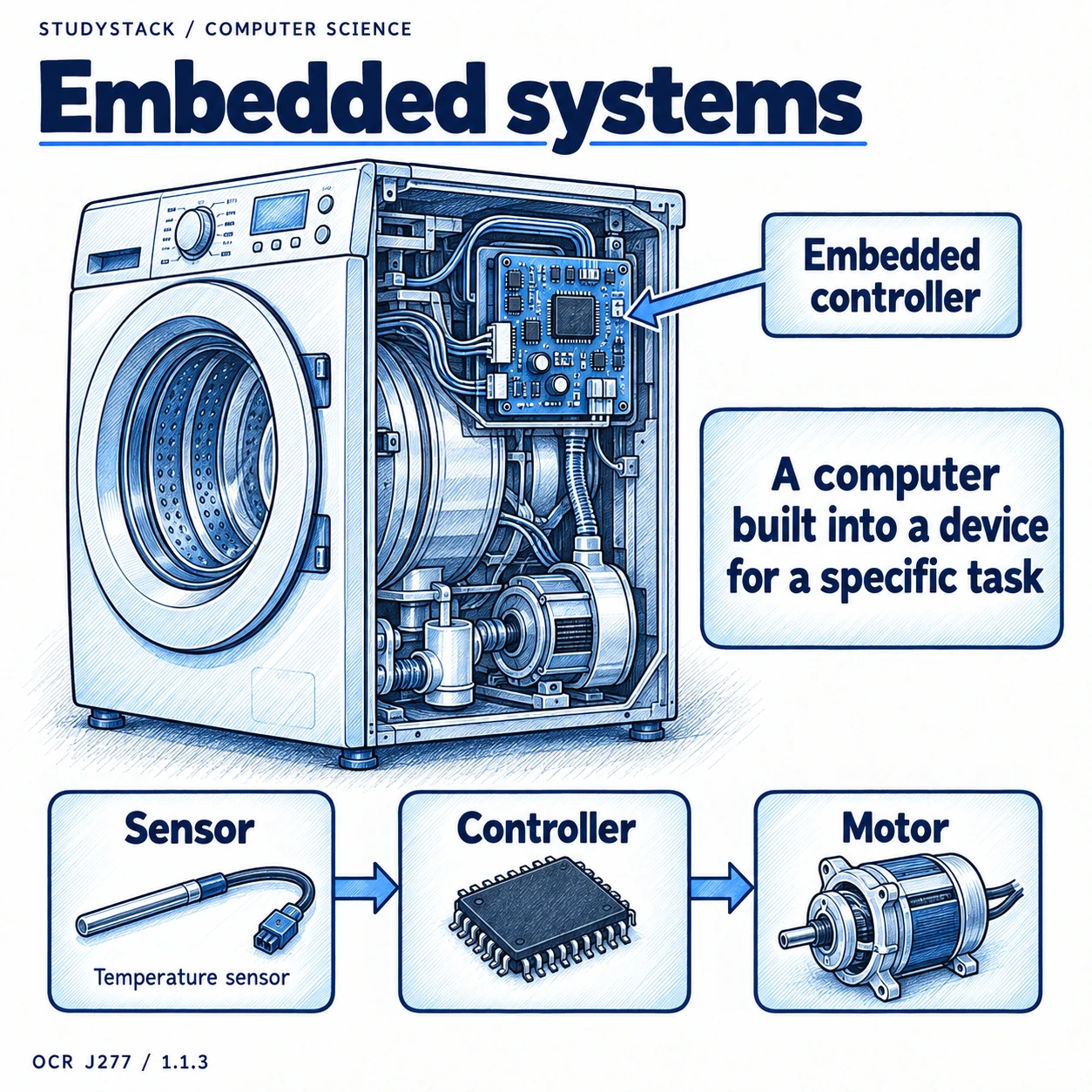
That purpose might be to control temperature, monitor sensors, respond to button presses, display information, or manage part of a larger machine. Even though these devices may not look like computers, they still contain processors, memory, and software.
- Embedded systems are built into larger devices.
- They are designed for a specific function or a small set of closely related functions.
- They are different from general-purpose computers such as laptops and desktop PCs.
- They are found in many everyday products and industrial systems.
Simple exam definition
A strong definition is: an embedded system is a computer built into a device to perform a specific task.
Must Know
Examples of embedded systems
You need to be familiar with a range of embedded systems, and it helps to think about where they appear in everyday life.
Common examples include washing machines, microwaves, fridges, digital cameras, sat nav devices, cars, traffic lights, medical equipment, digital clocks, vending machines, and lifts.
For example, the embedded system in a washing machine controls the wash cycle, water temperature, and spinning. In a sat nav, it processes location data and gives directions. In a central heating controller, it reads sensors and turns the heating on or off to maintain the chosen temperature.
- Home appliances: microwave, washing machine, oven, fridge.
- Transport: cars, aircraft systems, sat nav devices, traffic lights.
- Consumer electronics: cameras, televisions, digital clocks.
- Public and industrial systems: vending machines, lifts, medical equipment.
Helpful way to revise
When learning examples, pair each device with its specific job. That makes it easier to explain why it counts as an embedded system.
Core Knowledge
Typical characteristics of embedded systems
The point of an embedded system is to do its job reliably without needing the large resources of a general-purpose computer.
Because the task is narrow, embedded systems do not need a full desktop operating system or lots of storage. They are often designed to start quickly, use little power, and keep running without interruption.
Many also interact directly with physical inputs and outputs. A sensor may detect temperature, movement, or light, while an actuator may switch on a motor, heater, alarm, or display.
- Designed for a specific task.
- Uses minimal resources such as memory, storage, and processing power.
- Often has software stored in ROM or other non-volatile memory.
- Usually has a very simple user interface, or no user interface at all.
- Often uses sensors, timers, and actuators to react to the real world.
- Built to be reliable because many run continuously or control important equipment.
Key phrase to remember
Embedded systems are usually reliable, efficient, and purpose-built rather than flexible and general-purpose.
How They Work
Software, ROM, and operating systems
Embedded systems are closely linked to ROM because the control program is usually stored permanently and must be available as soon as the device powers on.
The embedded program is often stored in ROM or similar non-volatile memory, so it is not lost when the power is turned off. This means the device can start performing its task straight away when switched on.
Embedded systems also tend to have a very limited operating system, or software that directly controls the hardware. Unlike Windows or macOS, it is not designed to run lots of different applications for the user.
- Software is commonly stored in ROM or similar memory.
- The program is available immediately on power-up.
- The operating system is limited compared with a desktop computer.
- The system usually runs one dedicated application.
Exam precision
Do not describe an embedded system as a normal PC with fewer features. Its software and operating system are designed around one specific job.
Comparison
Embedded systems vs general-purpose computers
A comparison question is really testing whether you understand why embedded systems are specialised.
| Feature | Embedded system | General-purpose computer |
|---|---|---|
| Main purpose | Carries out one specific task | Runs many different applications |
| Resources | Usually minimal and efficient | Usually much larger and more flexible |
| User interface | Simple or none | Complex interface for many tasks |
| Software | Dedicated program often stored permanently | Many programs can be installed and changed |
| Operating system | Very limited or specialised | Full operating system |
High-Value Exam Skill
Why reliability matters so much
Reliability is one of the most important characteristics of embedded systems because many control real devices in the real world.
If an embedded system in a microwave, car, lift, or medical device fails, the consequences can be far more serious than a minor software crash on a home computer. That is why these systems are often designed to be simple, efficient, and dependable.
Using limited resources is not just about saving money. It also helps keep the system focused on the task it must perform, which can reduce complexity and improve reliability.
- Many embedded systems run all the time or for long periods.
- Some control safety-critical or important equipment.
- A simple, focused design can make the system more dependable.
- Low power use and fast start-up are often useful side benefits.
Strong exam sentence
Embedded systems are designed to be reliable because they often control important real-world devices and must keep performing their specific task correctly.
Key takeaways
- An embedded system is designed to do one specific job, not lots of different jobs.
- Embedded systems usually use minimal resources and are built to be reliable.
- Their software is commonly stored in ROM or similar non-volatile memory.
- Many everyday devices contain embedded systems even if they do not look like computers.
Glossary
- Embedded system
- A computer built into a larger device to perform a specific task.
- ROM
- Read Only Memory, non-volatile memory often used to store the embedded program.
- Sensor
- A device that detects changes in the environment, such as temperature, light, or movement.
- Actuator
- A component that carries out an action, such as switching on a motor, alarm, or heater.
- General-purpose computer
- A computer designed to run many different applications rather than one dedicated task.
Test yourself
5 questions
What is an embedded system?
A computer built into a device to perform a specific task.
Name three examples of embedded systems.
Examples include a washing machine, sat nav device, microwave, car control system, or traffic lights.
Where is the software in an embedded system commonly stored?
In ROM or similar non-volatile memory.
What kind of user interface do embedded systems usually have?
A very simple interface, such as buttons and a small display, or sometimes no user interface at all.
Why are embedded systems designed to be reliable?
Because they often control important real-world devices and need to keep carrying out their task correctly.
Common questions
What is an embedded system in GCSE Computer Science?
It is a computer built into another device to perform a specific task, such as controlling a washing machine, sat nav, or central heating system.
What are the main characteristics of embedded systems?
They are usually designed for one task, use limited resources, have simple user interfaces, store their software in ROM or similar memory, and are built to be reliable.
Why do embedded systems usually not need a full operating system?
Because they are built to do one dedicated job, so they do not need the flexibility of a general-purpose operating system that can manage lots of different applications.
Is a mobile phone an embedded system?
In OCR-style examples, mobile phones are often included because they contain built-in computer systems controlling specific hardware functions, although they are more complex than simple single-purpose devices.